
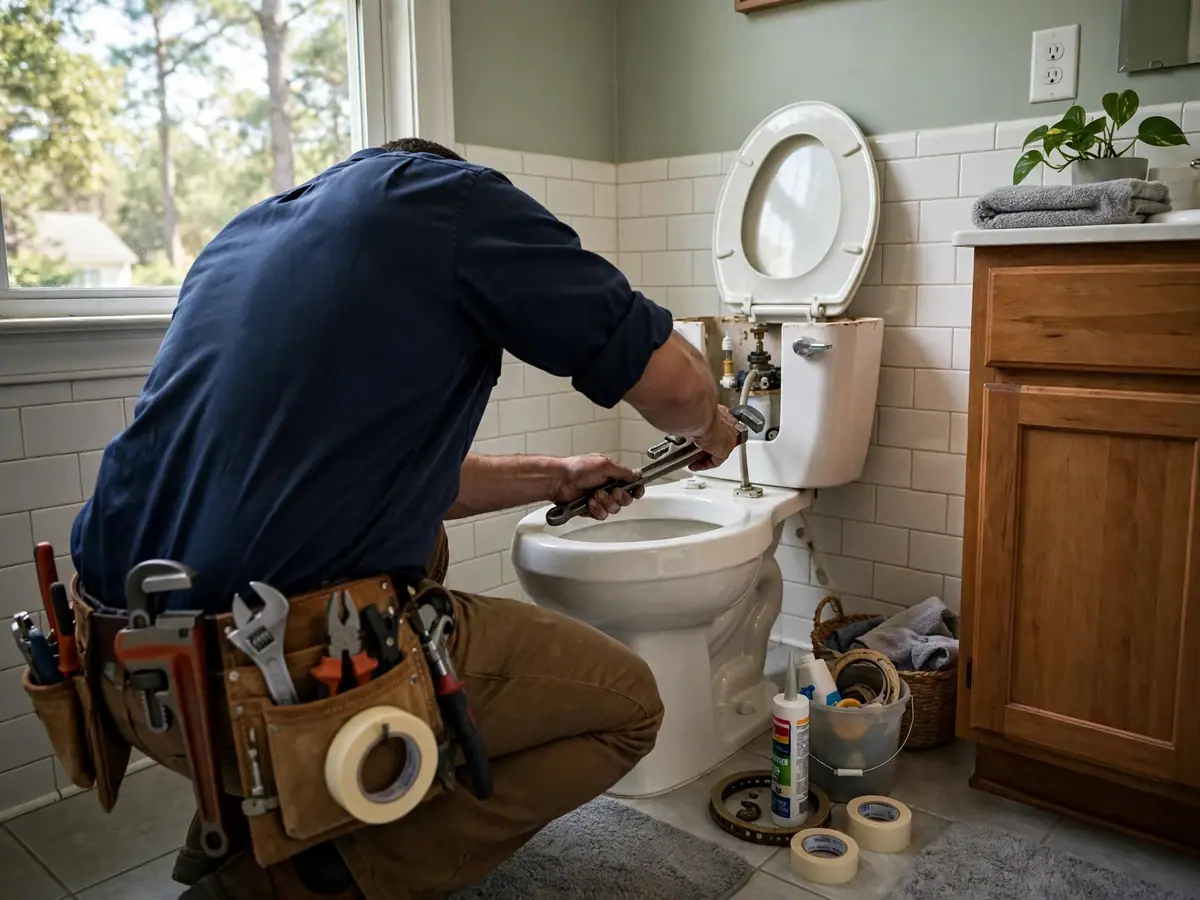
Emergency toilet repair in Cheshire, CT starts with the small shutoff valve behind the bowl. Turn it clockwise to stop water refilling the tank, and lift the tank lid to hold the flapper closed if the bowl is rising. Our 24/7 line is open, and a plumber can help you decide what to do while the appointment is set.
Toilet repair covers the parts that fail inside the tank, the seal under the bowl, the flange on the floor and the drain behind it. Many repairs are small and quick, and a toilet more than a couple of decades old may be cheaper to replace.
A toilet overflowing: what to do first
Stop the water, then stop the flush. Close the supply valve on the wall, lift the tank lid and push the flapper down to prevent more water entering the bowl. Do not flush again. Use towels at the base and move rugs and anything absorbent.
If the toilet backs up repeatedly and a plunger does nothing, the clog may be beyond the toilet. If a tub or sink nearby also gurgles, the branch or main line needs clearing, and our drain cleaning team handles that.
Common toilet problems and likely causes
The symptom tells us where to look.
Running water in the bowl
A worn flapper or fill valve lets water leak into the bowl. Parts are inexpensive.
Water at the base
A failed wax ring or a loose closet bolt lets water escape at the floor. Replace the seal and check the flange.
Weak flush
Clogged rim jets, a low tank water level or a partial clog.
Rocking toilet
A loose flange or bolts. Do not ignore it, since a rocking toilet breaks the seal.
Toilet won't stop filling
The fill valve or float is misadjusted or worn.
The flange: the part people forget
The closet flange is the ring on the floor that the toilet bolts to and that connects the bowl to the drain. A cracked or corroded flange, or one sitting below the finished floor after new tile, can leave a toilet unstable and leaking. Repair kits and replacement flanges exist, and the right choice depends on the pipe material and how damaged the ring is.
Many Cheshire homes have a basement below the bathroom, and a leak at the toilet base shows up first as a stain on the ceiling below. If you see that stain, check the toilet base before you blame a supply pipe. A small, early leak is a quick repair, and a long one rots subfloor.
Repair or replace the toilet
A plumber compares the cost of parts with the age and condition.
Repair makes sense when
- The toilet is in good condition and parts are common
- The issue is a flapper, fill valve or wax ring
- The bowl and tank are not cracked
Replace when
- The porcelain is cracked
- The toilet flushes poorly even when clean
- Repairs keep adding up on an old unit
Toilet trouble?
Call the 24/7 line. Call to talk through fixing or replacing it.
What the code says about toilet repair
The model code behind Connecticut plumbing is the 2021 IPC, adopted through the 2022 State Building Code. A flange or wax ring repair rarely needs a permit, but moving a toilet to a new spot is a different job. We do not guess at permit rules on the phone. The Cheshire Building Department, 84 South Main Street, is the office that decides.
Other plumbing around the toilet
A leaking supply line or valve under a bathroom sink belongs under faucet repair. If water is coming through a ceiling below the bathroom, leak detection finds the source. We serve toilet calls across Cheshire and in Southington, Wallingford, Meriden and Prospect.
Toilet repair questions in Cheshire
Yes. (203) 720-6269 is answered 24/7. Close the valve behind the toilet and call.
Usually a worn flapper or fill valve. Both are quick repairs.
A failed wax ring or loose bolts are common causes, and sometimes the tank bolts or supply line. A plumber finds which and repairs it.
Many people can, though a cracked flange or a bad seal shows up later as leaks. A plumber handles the flange and the water connection.
It usually means a clog in the branch or main line, not the toilet itself.